

Table of Contents
- What a Modern Farmhouse Living Room Looks Like in 2026
- How to Mix Modern and Rustic Furniture in One Room
- The Modern Farmhouse Color Palette That Works in Any Light
- Affordable Farmhouse Decor Tips That Do Not Look Cheap
- Small-Space Living Room Solutions for Farmhouse Style
- Eco-Friendly Farmhouse Materials and Where to Use Them
- Seasonal Transitions: Updating Your Farmhouse Living Room Through the Year
- Conclusion
- Frequently Asked Questions
Last Updated: September 28, 2026
What a Modern Farmhouse Living Room Looks Like in 2026
Modern farmhouse living room design ideas start with one simple rule: keep the bones clean and let the texture do the talking. At Kirkland Home Furniture, we've watched this style shift from heavy rustic to something lighter and more livable. The look pairs neutral walls with warm wood, soft textiles, and a few vintage accents.
So what defines the look now?
- Neutral palette with warm white and earth tones
- Natural materials like reclaimed wood and natural stone
- Textural contrast between smooth and rough surfaces
- Functional decor that earns its place
How to Mix Modern and Rustic Furniture in One Room
Mixing modern and rustic furniture works when you follow a 70/30 split. Keep most of the room clean and modern, then add rustic pieces as accents. This keeps the space timeless instead of themed.
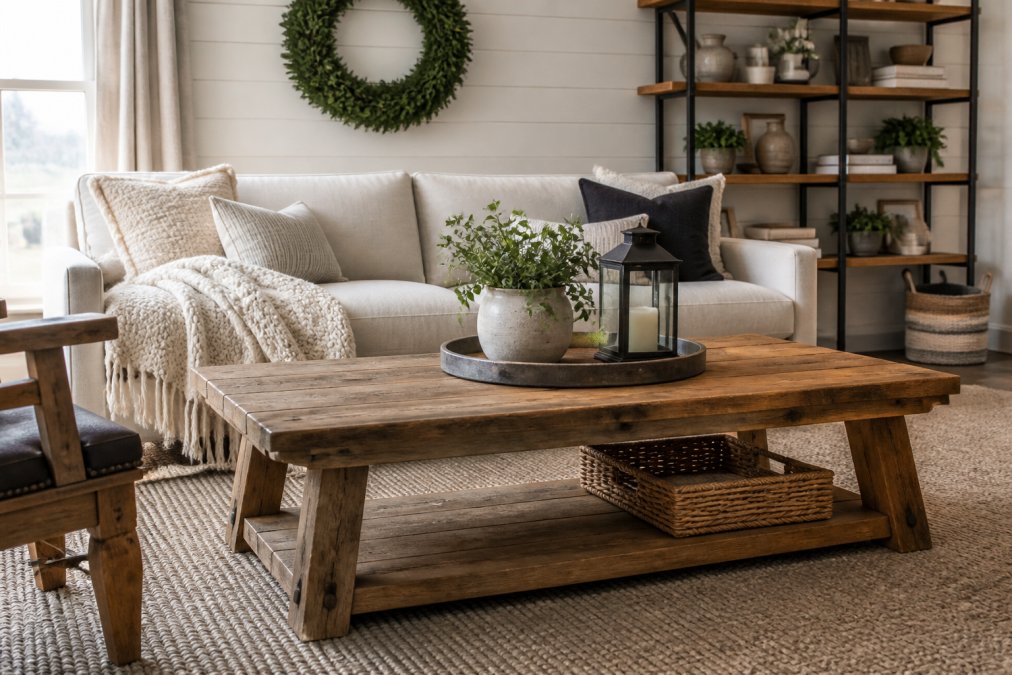
Pairing a Clean-Lined Sofa With Reclaimed Wood
A clean-lined sofa is your modern anchor. Pair it with a reclaimed wood coffee table or console. The smooth fabric against the rough grain creates instant visual interest.
Using Textural Contrast to Blend Old and New
Textural contrast is the secret to a blended style. Combine tufted leather with soft linen. Add a distressed finish next to a polished surface. Layer a chunky throw over a sleek sofa.
The Modern Farmhouse Color Palette That Works in Any Light
The modern farmhouse color palette is simple on paper: warm white as your base, earth tones for warmth, and one dark anchor for depth. What separates a room that works from one that looks muddy is understanding undertones and light reflectance value (LRV), the 0-100 scale printed on every paint chip that measures how much light a color bounces back.
Warm White, Earth Tones, and One Dark Anchor
Start with warm white on the walls. It reflects light without feeling cold. Add earth tones through wood, woven baskets, and accent pillows. Then choose one dark anchor, a charcoal sofa, a black metal light fixture, or a dark wood shelf, to ground the space.
- LRV 70-85: Warm whites and creams. Best for walls in rooms with at least one decent window.
- LRV 40-60: Greige, oatmeal, and soft taupe. Good for trim, cabinetry, or a secondary wall.
- LRV under 20: Charcoal, black, and deep olive. Reserve these for the anchor piece, not the walls.
How Light Direction Changes Your Palette
Light direction matters more than the paint name. Here is the pattern most designers work from:
- North-facing rooms: Cool, indirect light all day. Warm the palette with creams, honey-toned wood, and brass or aged-bronze hardware.
- South-facing rooms: Strong, warm light most of the day. Cool it slightly with greige walls, natural linen, and matte black accents.
- East-facing rooms: Warm morning light, cooler afternoons. A balanced warm white with a neutral undertone holds up best.
- West-facing rooms: Cool mornings, warm, glary afternoons. Mid-tone earth colors and textured fabrics soften the late-day glare.
The Three-Tone Rule (and When to Break It)
Keep it to three tones: base, mid, and anchor. More than that and the room starts to feel busy. The exception is a room with strong architectural interest, exposed beams, a stone fireplace, or original hardwood, where the architecture itself acts as a fourth tone and the walls should stay quiet.
Affordable Farmhouse Decor Tips That Do Not Look Cheap
Affordable farmhouse decor comes down to texture, not price. You can style a room on a budget and still make it look high-end, but the biggest missed opportunity in most farmhouse rooms is the wall itself. Shiplap and board-and-batten are the two wall treatments that define the style, and both are achievable as weekend DIY projects for a fraction of what a contractor charges.
The Budget Rules That Actually Hold Up
Before you touch a wall, get the basics right:
- Shop open shelving in solid wood over particle board. Solid pine or poplar takes stain and paint; particle board swells when it gets wet.
- Layer lighting with mason jar pendants and fairy lights on a dimmer. One overhead fixture flattens a room; three light sources at different heights add depth.
- Use baskets for storage that doubles as decor. Seagrass and jute read as intentional; plastic bins do not.
- Buy one statement piece instead of five small ones. A single reclaimed wood console outperforms a cluster of tchotchkes.
- Skip printed "farmhouse" signs. They date fast and read as cheap. Real materials age well; novelty items do not.
DIY Shiplap: What It Costs and How It Goes Up
Shiplap is horizontal wood paneling with a rabbeted edge that creates a shadow line between boards. You have three realistic paths:
- Real wood planks (1x6 or 1x8 pine): The traditional look. Boards run roughly $1-$2 per linear foot at most lumberyards, plus paint. Heavier, and you need a nail gun and a stud finder.
- MDF shiplap panels: Pre-primed, lightweight, and consistent. Easier to cut with a miter saw and forgiving for beginners. Slightly less texture than real wood.
- Peel-and-stick shiplap: Best for renters or accent walls. No nails, removable, but limited to flat, clean surfaces and not ideal behind a fireplace or in humid rooms.
DIY Board-and-Batten: The Cheaper, Cleaner-Lined Option
Board-and-batten uses vertical battens (thin strips) over a flat backing board, creating a grid of raised lines. It reads slightly more modern than shiplap and is generally cheaper because you use less wood.
- Materials: 1x2 or 1x3 battens, a 1/4-inch plywood or MDF backing, construction adhesive, brad nails, caulk, and paint.
- Layout: Space battens 12-16 inches on center for a classic look, or 18-24 inches for a more open, modern grid. Mark every stud first, battens should land on studs wherever possible.
- Cost logic: Battens are the cheap part. The backing board and paint are where the budget goes. A full wall typically costs less than a comparable shiplap wall because you are covering less surface with dimensional lumber.
- Time: One weekend for a standard accent wall, plus a day for caulk and two coats of paint.
Which Treatment Belongs Where
- Shiplap: Best on a fireplace wall, behind a sofa, or in a mudroom. The horizontal lines widen a narrow room.
- Board-and-batten: Best in entryways, behind a bed, or on a full wall where you want height. The vertical lines make ceilings feel taller.
- Neither: Skip both on a wall with a large window or a wall you plan to cover with art. The texture competes with the focal point.
Small-Space Living Room Solutions for Farmhouse Style
Small-space living rooms need furniture that does two jobs. Farmhouse style fits small rooms well because it favors function and light colors. The goal is to keep the floor visible and the walls working.
Try these moves:
- Choose a sofa with exposed legs to show more floor
- Use a round coffee table to ease tight walking paths
- Mount open shelving instead of bulky cabinets
- Pick a light rug to make the room feel bigger
- Keep one focal point, not three
Eco-Friendly Farmhouse Materials and Where to Use Them
Eco-friendly farmhouse materials last longer and look better with age. Choosing them is both a style call and a smart one. Look for reclaimed wood, natural stone, and natural fiber textiles.
Where each material works best:
| Material | Best Used For | Why It Works |
|---|---|---|
| Reclaimed wood | Coffee tables, shelving | Adds history and warmth |
| Natural stone | Fireplace surrounds, side tables | Durable and timeless |
| Linen and cotton | Sofas, curtains, throws | Soft, breathable, easy to clean |
| Wool | Rugs, chunky throws | Cozy and long-lasting |
| Rattan and wicker | Baskets, chairs | Light look, strong build |
Seasonal Transitions: Updating Your Farmhouse Living Room Through the Year
Seasonal transitions keep a farmhouse living room fresh without a full redesign. Swap a few textiles and accents as the weather changes. The bones of the room stay the same.
A simple year-round plan:
- Spring: lighter throws, fresh greenery, brighter pillows
- Summer: cotton slipcovers, woven baskets, airy curtains
- Fall: wool throws, earth tone pillows, a wreath
- Winter: chunky knit blankets, warm lighting, layered rugs
Conclusion
Styling a farmhouse living room that feels warm and modern takes the right mix of texture, color, and function. Kirkland Home Furniture can help you find pieces built for real life, from clean-lined sofas and reclaimed wood tables to cozy textiles and open shelving. Stop by our showroom to test the furniture in person and see how each piece fits your space.
Frequently Asked Questions
What does a modern farmhouse living room look like?
A modern farmhouse living room blends clean modern lines with rustic warmth. You will typically see a neutral palette of warm white and earth tones, a mix of natural materials like reclaimed wood and natural stone, textural contrast from chunky throws and tufted leather, and functional decor such as open shelving and a simple wreath. The goal is a cozy, timeless space that feels curated rather than cluttered.
How do you balance modern and rustic elements in a living room?
Start with a modern anchor piece, such as a clean-lined sofa or a minimalist coffee table, then layer in rustic elements like a reclaimed wood console, a distressed finish, or vintage accents. Keep the ratio roughly 60 percent modern to 40 percent rustic so the room reads as blended style rather than themed. Textural contrast, such as pairing smooth leather with a chunky throw, keeps the mix from feeling flat.
Is modern farmhouse still in style in 2026?
Yes. Modern farmhouse has moved away from the heavy shiplap-and-signs look toward a more curated, blended style. In 2026 the trend favors warm white walls, natural stone, open shelving, and fewer but better pieces. It remains popular because the neutral palette and natural materials work in both country homes and modern interiors, and the style adapts easily to decorating on a budget.
What are common mistakes in farmhouse decor?
The most common mistakes are overusing one material, such as covering every wall in shiplap or board and batten, and filling shelves with too many small accessories. Another is ignoring scale: an oversized tufted leather sofa in a small room kills the airy feel. Finally, skipping a focal point, like a fireplace, a large window, or a statement light fixture, leaves the room without direction. Choose a few strong pieces and let them breathe.